Sharpvue OS vs. Giraffe: fleet software for surveillance trailers and CCTV towers
Most comparisons in this category are about the trailer. This one is about the software that runs it. Sharpvue OS and Giraffe both manage a fleet of off-grid camera units from one login, and they make different choices about where video lives, how faults get fixed and who the product is sold to.
In short:Giraffe is a controller board and cloud platform from a UK company, aimed at manufacturers who build rapidly deployable CCTV towers and want software to put inside them. It is well documented, has a public API and can be white labelled. Sharpvue OS is the operating system on Sharpvue's own trailers and portable units, built and supported in the United States. It records continuously to the cloud, repairs routine faults by itself, includes the managed cellular uplink, and is an open video platform that works with three supported platforms or a VMS you already run. It has its own API, SURGE, and co-branded white label for dealers and partners. If you build towers in volume and want a board to design around, Giraffe is a credible option. If you operate or resell units in North America and want one vendor accountable for the whole system, that is the case for Sharpvue.
This page is published by Sharpvue, which makes Sharpvue OS. Sharpvue is not affiliated with Giraffe CCTV or Rugged Networks Limited. Statements about Giraffe come from Giraffe's own website and public documentation as of November 2026 and are cited at the foot of the page. A note on terms: Giraffe writes for the UK market, where a mobile surveillance unit is usually a “CCTV tower” and a monitoring center is an “alarm receiving centre” (ARC).
| Category | Sharpvue OS | Giraffe |
|---|---|---|
| What it is | One operating system on every Sharpvue unit, managing cameras, cellular failover, solar charge and battery, and deterrence hardware together. Surfaced through iVISION (cloud VMS), MySharpvue (fleet portal) and ODIN (AI engineer). | Giraffe Cloud (also called ONVP): a hosted web platform for managing a fleet of rapidly deployable CCTV systems. Private cloud hosting is available on request. |
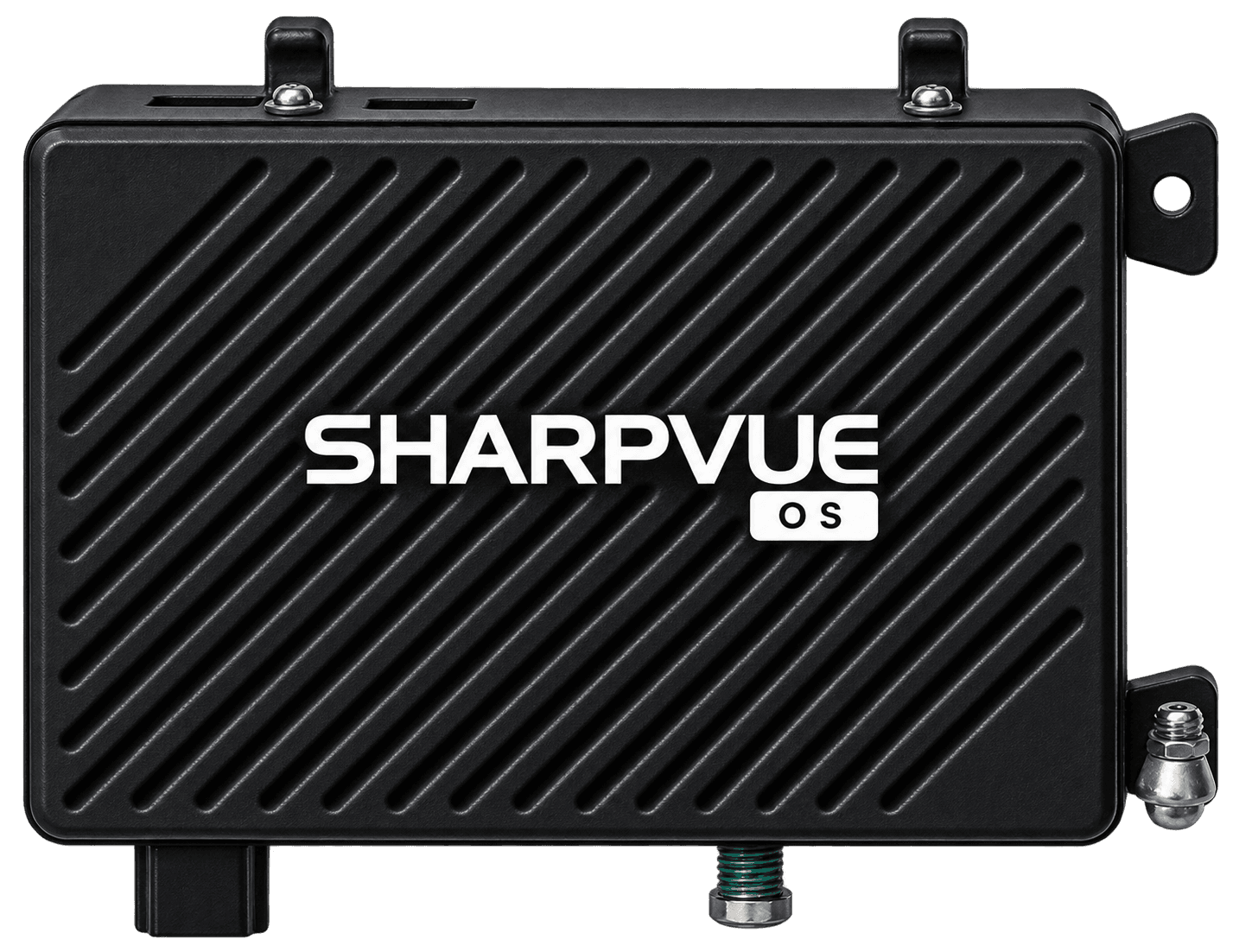
| On-unit hardware | Lightweight, and not tied to one device. It runs on the Sharpvue Gateway inside each trailer and portable unit, and can run on any open-platform Linux device, including cameras and the Sharpvue BLAST horn speaker. | The Edge Controller, a PCB inside each system. Edge Controller V2 lists an M.2 SATA slot for an SSD, AI on a Google Coral chip, 8 monitored power outputs, 8 isolated inputs, 4 serial ports, an always-on GPS tracker and a typical draw of 2–3 W. |
| Fitting it to units you already own or build | BYOT: Sharpvue converts an existing surveillance trailer from any manufacturer by replacing the top box, and the converted unit runs Sharpvue OS. Each trailer is appraised individually; fleets can be converted in batches. | Edge Controllers can be fitted to a manufacturer's own systems. Giraffe describes OEM integration as suitable for manufacturers building 25+ near-identical systems with strong electrical and software skills, and as not viable for one-off builds. Its Mobile Security Units can be fitted to existing towers or poles. |
| Where video is recorded | Open platform: video can be recorded wherever you choose. On iVISION it records continuously to the cloud with no storage cap, with exports on demand. Units on Alarm.com for Business or OpenEye record the way those platforms do, and RTSP streams can be recorded by a private or Sharpvue-hosted VMS. | A “hybrid” model: camera streams record continuously to a local disk plugged into the Edge Controller, and AI events such as person or vehicle detections are uploaded to the platform for offsite storage. Playback streams from the unit on request. |
| Video platform choice | Open platform. Choice of Sharpvue iVISION, Alarm.com for Business or OpenEye, or a VMS you already run: Sharpvue delivers RTSP streams from the Sharpvue cloud to any private VMS, publishes streams from the Sharpvue Gateway to a privately hosted VMS, and can install and host a third-party VMS in Sharpvue's cloud infrastructure. Cameras support ONVIF. | Giraffe Cloud is the operating platform. An RTSP service proxies camera streams out without port forwarding or a static IP. |
| Camera support | Any camera, any brand, with an RTSP stream and ONVIF support. Units ship configured with Sharpvue NDAA-compliant cameras by default. | “Any camera brand, any camera.” The Edge Controller is designed for 4 cameras with two streams each; it can work with more, which Giraffe says is not what it was designed to do. |
| AI detection & deterrence | People and vehicles detected and boxed live in iVISION. The OS manages the unit's strobe, siren and talk-down hardware. | Person and vehicle detection on the Edge Controller. Active Threat Deterrence switches on strobes, floodlights or a siren; an optional Virtual Security Guard delivers an audio talk-down. |
| Power monitoring | Battery voltage and state of charge with the trend behind it, and solar harvest against live load. Integrates with EFOY fuel cells and the Sharpvue DC CORE generator, recording fuel level, run state and charge delivered. Every reading carries its age, so stale numbers are flagged. | Direct Victron VE.Direct and EFOY fuel-cell integration showing generation, consumption and battery state, with daily energy forecasts expressed as days remaining. |
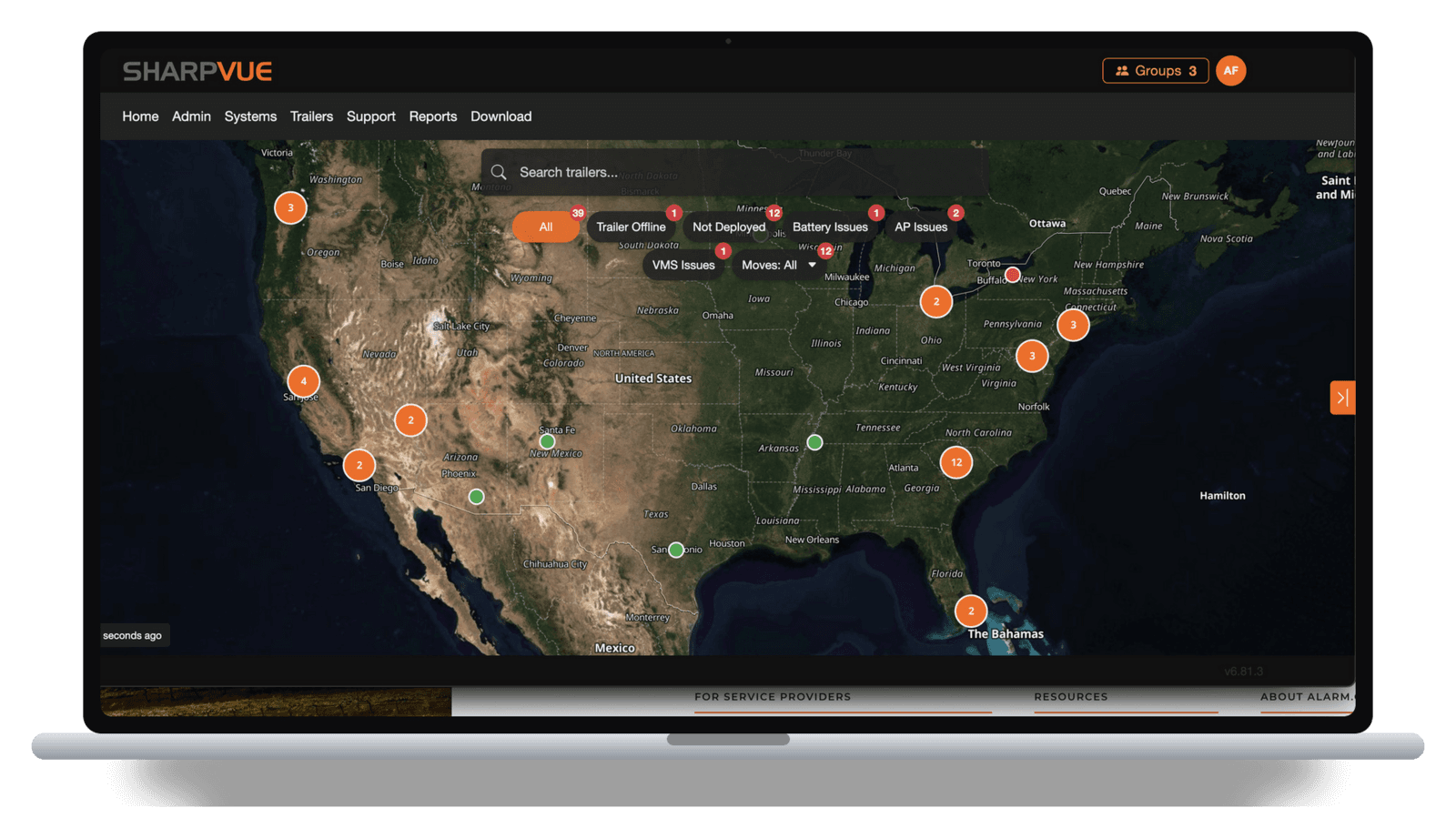
| Fleet health | Carrier, signal strength, VMS, gateway, access point and per-camera status for every unit, on a live fleet map with triage filters for offline, battery, access point and VMS faults. | Low-battery and device-fault notifications, and configurable energy thresholds that raise error states on a system. |
| Remote fixes & self-healing | Auto-healing: the OS detects a fault, runs a targeted remedy (power-cycle, re-provision or restart), verifies that the fix took, and escalates to a person when it does not clear. | Remote reboot, reset and connectivity diagnostics, and a “lights out” controller that can switch a unit off and on remotely with the main router powered off. The self-healing documentation lists USB device disconnections and hard drive errors. |
| AI diagnostics assistant | ODIN reads a unit's power, connectivity, VMS, gateway and camera state, explains the fault in plain language with the supporting telemetry, runs the repair on the operator's say-so and confirms the result. | Not publicly specified |
| Cellular connectivity | Multi-carrier 5G/LTE with automatic failover between networks. Managed SIMs and data ship with the unit; Starlink is an option. | Works with routers from any manufacturer, with native integrations for Teltonika and Peplink. Giraffe Care offers mobile data services. |
| GPS & fleet logistics | Live position for the whole fleet, move requests tracked from requested through delivered to redeployed, live GPS and ETA on the leg, and a site history for each unit. | An always-on GPS tracker with an internal backup battery on Edge Controller V2. |
| Dealers, resellers & customers | One account for dealer, customer and Sharpvue support, scoped by permission, with groups by customer, region or job site and uptime reporting. | Parent and child teams, one level deep, for security firms that rent systems to customers, with permissions and audit logs. |
| Monitoring-center integrations | Integrates with remote video monitoring centers, including Becklar/Eyeforce and EyeQ Monitoring. Operators work alongside iVISION, Alarm.com for Business or OpenEye. | Integrated with Sentinel and Immix alarm receiving centre software, with other integrations available, plus a built-in alarm view for self-monitoring. |
| API | SURGE (Sharpvue Unified REST Gateway Exchange): a REST API with versioned endpoints, automatically generated OpenAPI specifications, scoped API keys and a developer console. | A documented HTTP API (ONVP Public API v2), an Edge Controller API and an RTSP proxy API, with personal access tokens. |
| White label | Co-branded white label is available for dealers and partners. | Giraffe Cloud can be white labelled with your logo and login background, on a subdomain of onvp.io. |
| Login & stream security | Two-factor and multi-factor authentication on login. Video streams travel inside an encrypted private network between the unit and the Sharpvue cloud, so cameras are not exposed to the public internet. | Multi-factor authentication, user permissions and SSL, with video described as encrypted end to end over WebRTC. |
| Mobile apps | iVISION has native iOS and Android apps alongside the web client. | The Giraffe CCTV app is on the Apple App Store and Google Play. |
| Where it is based & markets served | Based in Chapin, South Carolina, where Sharpvue designs, manufactures and supports its units. 100% focused on the United States today, with plans in place to expand to the EU, Australia and New Zealand. | Rugged Networks Limited, registered in Barnstaple, Devon, UK. The Edge Controller is described as “designed and built in the UK”. Giraffe states 1,000+ systems and says its products are available in the UK, USA, Europe, Middle East and Asia. Its terms are governed by English law. |
| Published pricing | No prices are published. A similar structure, billed monthly: the unit is bought or rented, and Sharpvue OS is billed monthly, per unit. | No prices are published. The Edge Controller is described as “One price, one annual technology fee”; the Hub Controller as a one-off hardware payment plus a three-year licence. |
“Not publicly specified” means the information was not found in that company's public materials during our last review — it does not mean the capability is absent. Ask the vendor directly.
Two different things to buy
Giraffe's documentation describes four products: Giraffe Cloud, the web platform; Edge Controllers, the circuit board inside each system; complete Mobile Security Units and CCTV towers; and Giraffe Care, which covers mobile data and managed IT support. It states plainly that the Giraffe Cloud cannot be used without Edge Controllers, and that Edge Controllers can be fitted to a manufacturer's own systems.
That second route comes with conditions Giraffe publishes itself. OEM integration is described as suitable for manufacturers who build 25 or more systems, build them near enough identical, will modify their electrical design to suit the controller, and have a high level of electrical and software understanding. Giraffe says it is not viable to configure the controller for one-off builds.
Sharpvue OS is software rather than a board. It is lightweight and does not need Sharpvue's own hardware: it runs on the Sharpvue Gateway inside every unit Sharpvue builds — the MAST and MAST-mini trailers and the PSU and SPSU portable units — and it can run on any open-platform Linux device, including cameras and the Sharpvue BLAST horn speaker. For trailers you already own, Sharpvue's BYOT program replaces the top box on a trailer from any manufacturer and leaves the chassis, mast, solar and batteries in place. Each trailer is appraised individually, and fleets can be converted in batches.
Interpretation:a tower manufacturer with its own engineers and a production line is Giraffe's customer. A dealer, integrator or fleet owner who wants working units and one company to call is Sharpvue's.
Where the video lives
This is the clearest functional difference between the two. Giraffe documents a “hybrid” storage model: the camera streams record continuously to a local disk plugged into the Edge Controller, and AI events such as person or vehicle detections are uploaded to the platform for offsite storage. When you play footage back, the controller opens a tunnel and streams it to you from the unit. Giraffe states the benefit directly: everything is recorded around the clock, and bandwidth is kept to a minimum because footage is only sent when it is needed.
Sharpvue's iVISION takes the other side of that trade. It streams from the unit to the cloud and records continuously there, with no storage cap, so the recording is held away from the unit. That uses more cellular data, which is why managed multi-carrier data ships with every Sharpvue unit.
iVISION is not the only place a Sharpvue unit can record. Because the video platform is open, recording can happen wherever you choose: in Alarm.com for Business or OpenEye, in a VMS you host privately, or in a third-party VMS that Sharpvue hosts for you.
Interpretation: the question to ask is what footage still exists if the unit itself is stolen, burned or loses power for good. With recording on a local disk, the continuous footage is in the unit; the uploaded events are what survives offsite. With cloud recording, the footage up to the moment the unit went dark is already elsewhere. If your sites have weak cellular coverage or you pay for data by the gigabyte, the hybrid model has a real cost advantage, and you should weigh it.
When something breaks at 2 AM
Both platforms let an operator fix a unit without driving to it. Giraffe publishes remote reboot, reset and connectivity diagnostics, automatic alerts for low battery and device faults, and an independent “lights out” controller on Edge Controller V2 that can switch the unit off and on even with the main router powered down. Its self-healing documentation lists two cases: USB device disconnections and hard drive errors.
Sharpvue OS is built around doing the repair without being asked. Auto-healing watches every subsystem, and when it finds a hung access point, a stuck gateway or a VMS that has stopped recording, it runs a targeted fix, verifies that the fix took, and hands the problem to a person only if it does not clear. ODIN, the AI engineer built into the platform, reads the same telemetry and explains what went wrong in plain language, then offers to run the repair. More on both on the Sharpvue OS page.
Giraffe describes an “agentic AI module” on its website. Its public documentation describes that AI as intruder detection and automatic deterrence. A conversational assistant for diagnosing unit faults is not described in the materials we reviewed, so we do not characterize it either way.
Power monitoring
Both platforms treat power as a first-class signal. The Edge Controller connects directly to Victron solar chargers and battery shunts over VE.Direct and to EFOY fuel cells, with no third-party app in between. The platform archives generation, consumption and battery data, and produces a daily energy forecast expressed as days remaining, with Critical, Caution and OK bands and configurable thresholds that raise an error state. Edge Controller V2 also carries a compass and movement sensor so the platform knows which way the solar panels face.
Sharpvue OS reports battery voltage and state of charge with the trend behind them, and solar harvest against live load, and it stamps every reading with its age so stale numbers are flagged rather than trusted. It works with EFOY fuel cells and with Sharpvue's own DC CORE generator as well, pulling fuel level, run state and the charge delivered into the same telemetry. Because Sharpvue builds the power system as well as the software, the telemetry describes one known design rather than whatever a builder has wired in. Before a unit is ordered, Build a Trailer checks the planned load against the solar and battery for the site's solar zone.
Open in different places
Giraffe is open at the software-integration layer. It publishes an HTTP API, an Edge Controller API and an RTSP service that proxies camera streams out without port forwarding or a static IP. The cloud platform can be white labelled with your logo on a subdomain of onvp.io, and parent and child teams let a security firm give each rental customer a separate space. For a company that wants to build its own product on someone else's platform, that is a real offer.
Sharpvue video is an open platform. The same unit can run on Sharpvue iVISION, Alarm.com for Business or OpenEye, and it is not limited to those three. Sharpvue delivers RTSP streams from the Sharpvue cloud to any private VMS, publishes streams straight from the Sharpvue Gateway to a privately hosted VMS, and can install a third-party VMS in its own cloud infrastructure and host it for the customer. On the camera side it supports any camera from any brand with an RTSP stream and ONVIF support. A dealer who already sells Alarm.com or OpenEye keeps selling it. See open vs. proprietary surveillance platforms for why that matters over the life of the hardware.
Sharpvue has an API of its own: SURGE, the Sharpvue Unified REST Gateway Exchange, with versioned endpoints, automatically generated OpenAPI specifications, scoped keys and a developer console. Sharpvue also offers co-branded white label for dealers and partners. On API and branding the two are closer than they first appear, so ask both for the API reference and an example of a branded deployment.
Connectivity and who manages it
Giraffe's platform works with routers from any manufacturer and has native integrations for Teltonika and Peplink, using the router's local API and the manufacturer's own cloud. Mobile data is available separately through Giraffe Care, as a managed service or as parts for your own team to run.
On Sharpvue units the uplink is part of the product: multi-carrier 5G/LTE with automatic failover between networks, managed SIMs and data included with the unit, and Starlink as an option where there is no cell coverage. The operator does not source SIMs or troubleshoot a router.
Monitoring centers and moving units
Giraffe integrates natively with Sentinel and with Immix, two platforms used by alarm receiving centres, offers other integrations on request, and has a built-in alarm view for companies that monitor their own units. Sharpvue integrates with remote video monitoring centers, including Becklar/Eyeforce and EyeQ Monitoring, and their operators work alongside whichever video platform the unit runs. If you already work with a monitoring center, ask both vendors to confirm that specific integration in writing.
Both platforms track where units are. Edge Controller V2 has an always-on GPS tracker with its own backup battery. Sharpvue OS adds the work around the move: a move request tracked from requested through delivered to redeployed, live GPS and ETA on the leg, and a site history for every unit.
Where each company is based and the markets it serves
Giraffe is Rugged Networks Limited, registered in Barnstaple, Devon, in the United Kingdom. It began as AgriCamera, building remote livestock monitoring, and moved into security in 2021. It describes its Edge Controller as designed and built in the UK and states more than 1,000 systems. Giraffe says its products are available in the UK, the USA, Europe, the Middle East and Asia, and its terms are governed by English law. A US office, US support hours and where data is hosted are not stated in its public materials.
Sharpvue is based in Chapin, South Carolina, where it designs, builds and supports its units, and it is 100% focused on the United States today. Sharpvue has plans in place to expand to the EU, Australia and New Zealand; those markets are not served yet.
Neither product is as new as its current name. Giraffe launched under that brand in 2021 on a platform its founders had been building since the AgriCamera years. Sharpvue announced the Sharpvue OS name publicly in September 2026, but the software has been the core of every Sharpvue product since the company was founded in 2015. Sharpvue's CEO has worked in cloud video surveillance companies since 2008 and was an early adopter of cloud video, helping bring it into major corporations around the world.
Interpretation:the two companies are each strongest at home. A UK or European tower operator is closer to Giraffe's support, time zone and monitoring-center integrations. A US buyer gets a vendor whose whole business, support team and monitoring partners are in the United States.
On paperwork: Sharpvue publishes its cameras as NDAA Section 889 compliant. Both platforms accept cameras from any brand: Giraffe says “any camera brand, any camera”, and Sharpvue OS supports any camera with an RTSP stream and ONVIF support. For a US public-sector or regulated buyer that makes the camera choice the thing to check, so ask either vendor for component-level documentation for the specific cameras that will be on the unit.
Login and stream security
Both companies take the same position: a camera unit should not be reachable from the open internet. Giraffe publishes multi-factor authentication, user permissions and SSL, and describes video as encrypted end to end over WebRTC, with a reduced attack surface compared with a recorder behind port forwarding. Sharpvue OS uses two-factor and multi-factor authentication on login, and carries video streams inside an encrypted private network between the unit and the Sharpvue cloud, so the cameras are never exposed to the public internet.
How each one is priced
Neither company publishes prices, and the two are structured alike: hardware first, then a recurring software fee. Giraffe describes the Edge Controller as “One price, one annual technology fee”, and the Hub Controller as a one-off hardware payment plus a three-year licence. With Sharpvue the unit is bought or rented and Sharpvue OS is billed monthly, per unit. The difference is the billing period: annual on one side, monthly on the other. Ask both for the recurring figure per unit and exactly what it covers.
Questions to ask both vendors
- 01Where does the continuous recording live, and what footage still exists if the unit is stolen or destroyed?
- 02When a unit goes offline at 2 AM, what does the platform do by itself before a person gets involved?
- 03What is the recurring fee per unit, what does it include, and what stops working if it lapses?
- 04Who supplies and manages the SIMs and data, and what happens when one carrier is weak at a site?
- 05Where are your support staff, and what hours do they cover in my time zone?
- 06Where are video, events and account data hosted?
- 07Can the unit feed the video platform or monitoring center I already use, and by what protocol?
- 08Which camera models are supported, and can you provide NDAA Section 889 documentation for each?
- 09Is there a minimum order or engineering commitment to put the software on units I already own?
- 10Is there an API, and can the portal carry my brand?
Sharpvue OS
Best for: US dealers, integrators and fleet owners who want the unit, the connectivity and the software from one manufacturer, with a choice of video platform on top
Sharpvue OS is the operating system on every Sharpvue trailer and portable unit. It runs the cameras, the multi-carrier cellular uplink, the solar charge and battery, and the strobe, siren and talk-down hardware as one system, and it surfaces through three things: iVISION (cloud video), MySharpvue (the fleet portal) and ODIN (the AI engineer that diagnoses and repairs units remotely). Video can run on iVISION, Alarm.com for Business or OpenEye, and Sharpvue video is an open platform: RTSP streams can be delivered from the Sharpvue cloud or the Sharpvue Gateway to a VMS the customer already runs, and Sharpvue can host a third-party VMS in its own cloud.
Strengths
- Continuous recording to the iVISION cloud with no storage cap, so footage is held off the unit
- Auto-healing that runs a targeted fix, then verifies it worked and escalates if it did not
- ODIN answers in plain language and carries out the repair on the operator's say-so
- An open video platform: three supported platforms, RTSP delivery to any private VMS from the cloud or the Gateway, and third-party VMS hosting in Sharpvue's cloud
- Supports any camera from any brand that offers an RTSP stream and ONVIF
- SURGE, a versioned REST API with OpenAPI specs, scoped keys and a developer console
- Lightweight software that runs on any open-platform Linux device, not only the Sharpvue Gateway
- Multi-factor login, with streams carried inside an encrypted private network
- Power telemetry that includes EFOY fuel cells and the DC CORE generator, down to fuel level
- Co-branded white label for dealers and partners
- Integrates with remote video monitoring companies Becklar/Eyeforce and EyeQ Monitoring
- Managed multi-carrier 5G/LTE ships with the unit, with Starlink as an option
- Move requests, live GPS and per-unit site history built into the same portal
- Converts an existing trailer from any manufacturer through the BYOT program
- The core of Sharpvue's products since 2015, from a founder who has worked in cloud video surveillance since 2008
- Designed, built and supported in Chapin, South Carolina, with the whole company focused on the US market
Points to compare
- Prices are quoted per configuration rather than published; Sharpvue OS is billed monthly per unit
- The Sharpvue OS name is new: it was announced publicly in September 2026, though the software has been the core of Sharpvue's products since 2015
Choose Sharpvue OS if: You operate or resell mobile surveillance units in North America and want one vendor accountable for the hardware, the uplink and the software, without being tied to a single video platform.
Strengths and points to compare are Sharpvue's interpretation of Sharpvue OS's publicly available information, not statements of fact. Sharpvue OS's official product information.
Giraffe
Best for: Manufacturers of rapidly deployable CCTV towers who want a controller board and cloud platform to design into their own product, particularly in the UK and Europe
Giraffe is a UK company that builds a controller board (the Edge Controller), its own Mobile Security Units and solar CCTV towers, and a cloud platform, Giraffe Cloud, that manages all of them. The Edge Controller acts as the recorder, the AI appliance and the power manager inside each unit. Giraffe sells complete units, and it also sells the controller to other manufacturers to build into their own towers. Its documentation is public and detailed, which is rare in this category.
Strengths
- Public, detailed documentation covering the platform, the controller and the towers
- A documented HTTP API, an RTSP service and API keys for building your own integrations
- White-label option for the cloud platform, under your own logo
- Direct Victron and EFOY fuel-cell integration, with energy forecasts shown as days remaining
- Native integrations with Sentinel and Immix alarm receiving centre software
- Edge Controller sold to other manufacturers, with a typical draw of 2–3 W
- Parent and child teams designed for security firms that rent units to customers
- Works with routers from any manufacturer, with native Teltonika and Peplink integrations
Points to compare
- Continuous video is kept on a disk in the unit; only AI events are uploaded for offsite storage
- OEM integration is described as suitable for manufacturers building 25 or more near-identical systems, and not viable for one-off builds
- Giraffe Cloud is the platform; it cannot be used without an Edge Controller
- Based in the UK and selling into several regions; a US office, US support hours and US data hosting are not stated in its public materials
- An annual technology fee applies to the Edge Controller, and the amount is not published
Choose Giraffe if: You manufacture your own towers in volume, have electrical and software engineers in house, want a board and an API to build on, and work with UK alarm receiving centres.
Strengths and points to compare are Sharpvue's interpretation of Giraffe's publicly available information, not statements of fact. Giraffe's official product information.
Relevant reading: Sharpvue OS · MySharpvue fleet portal · iVISION cloud VMS · Convert a trailer you own · Dealer program
- What is the difference between Sharpvue OS and Giraffe?
- Both are software for running a fleet of off-grid camera units from one login: live video, power and battery monitoring, alerts and remote control. They are sold differently. Sharpvue OS is the operating system on Sharpvue's own trailers and portable units, and on other manufacturers' trailers that Sharpvue converts; it is lightweight software that can run on any open-platform Linux device, including cameras and the Sharpvue BLAST horn speaker, and it works with a choice of three video platforms or a VMS you already run. Giraffe sells a controller board, the Edge Controller, together with its Giraffe Cloud platform, both inside its own towers and to other manufacturers who build the board into their products. The largest functional difference is recording: Sharpvue's iVISION records continuously to the cloud, while Giraffe records continuously to a disk in the unit and uploads AI events.
- Where are Sharpvue and Giraffe based, and is Giraffe available in the United States?
- Giraffe says its products are available in the UK, the USA, Europe, the Middle East and Asia. It is a UK company: Rugged Networks Limited, registered in Barnstaple, Devon, and its terms are governed by English law. A US office, US support hours and US data hosting are not stated in its public materials, so a US buyer should ask Giraffe directly about support coverage, where video events and account data are hosted, and how warranty returns work from North America. Sharpvue is based in Chapin, South Carolina, where it designs, builds and supports its units, and is 100% focused on the United States today, with plans in place to expand to the EU, Australia and New Zealand.
- Where is the video stored on each platform?
- Giraffe documents a hybrid model. The camera streams record around the clock to a local disk plugged into the Edge Controller, and AI events such as person or vehicle detections are uploaded to the platform for offsite storage. Playback is streamed from the unit when you ask for it, which keeps cellular data use low. Sharpvue's iVISION records continuously to the cloud with no storage cap, so the full recording is held off the unit. Sharpvue units running on Alarm.com for Business or OpenEye record the way those platforms do. Because Sharpvue video is an open platform, it can also record anywhere you choose, including a VMS you host privately or one Sharpvue hosts for you. Neither approach is wrong; they trade data use against how much footage exists away from the unit.
- Can I put Sharpvue OS or Giraffe on trailers I already own?
- Yes, in different ways. Sharpvue's BYOT program converts an existing surveillance trailer from any manufacturer by replacing the top box, and the converted unit runs Sharpvue OS; each trailer is appraised individually and fleets can be done in batches. Giraffe sells its Edge Controller to manufacturers to design into their own systems, and describes that route as suitable for companies building 25 or more near-identical systems with strong electrical and software skills, and as not viable for one-off builds. Giraffe also sells a complete Mobile Security Unit that can be mounted on an existing tower or pole.
- Does either platform fix faults on its own?
- Sharpvue OS includes auto-healing: it detects a fault such as a hung access point, a stuck gateway or a VMS that stopped recording, runs a targeted fix, checks that the fix worked, and escalates to a person if it did not. ODIN, Sharpvue's AI engineer, explains the fault in plain language and can run the repair when asked. Giraffe publishes remote reboot, reset and connectivity diagnostics, a controller that can switch a unit off and on remotely, and a self-healing page that lists USB device disconnections and hard drive errors. A conversational diagnostics assistant is not described in Giraffe's public materials; ask Giraffe what its “agentic AI” covers on the support side.
- Which one is more open?
- They are open in different places. Both have an API. Giraffe publishes an HTTP API, an RTSP service and a white-label option, which suits a company that wants to build its own software on top. Sharpvue video is an open platform at the video layer: the same unit runs on iVISION, Alarm.com for Business or OpenEye, and Sharpvue can also deliver RTSP streams from the Sharpvue cloud to any private VMS, publish streams from the Sharpvue Gateway to a privately hosted VMS, or install and host a third-party VMS in its own cloud infrastructure. Sharpvue also has a REST API, SURGE (Sharpvue Unified REST Gateway Exchange), with versioned endpoints, automatically generated OpenAPI specifications, scoped keys and a developer console. Sharpvue also offers co-branded white label for dealers and partners.
Comparing the trailers rather than the software? See the comparison center.
Research & methodology
This comparison is compiled from publicly available information, including each manufacturer's own website and product documentation. Where a specification, capability or price is not published by the vendor, this page states “Not publicly specified” rather than guessing — that phrase means the information was not found in public sources, not that the vendor lacks the capability.
Statements of fact are cited below. Sections labelled as considerations, “best for”, or “who should choose” are Sharpvue's interpretation of that public information, not statements of fact.
Last reviewed: November 2026
Competitor products and services change. Prospective buyers should verify current specifications and pricing directly with each manufacturer before making a purchasing decision.
Sources
- Giraffe CCTV (Rugged Networks Limited) — Documentation — What is Giraffe? (accessed 2026-11-15)
- Giraffe CCTV (Rugged Networks Limited) — About Giraffe (accessed 2026-11-15)
- Giraffe CCTV (Rugged Networks Limited) — Giraffe Platform — software (accessed 2026-11-15)
- Giraffe CCTV (Rugged Networks Limited) — Documentation — Edge Controller V2 overview (accessed 2026-11-15)
- Giraffe CCTV (Rugged Networks Limited) — Documentation — Recording (accessed 2026-11-15)
- Giraffe CCTV (Rugged Networks Limited) — Documentation — RTSP service (accessed 2026-11-15)
- Giraffe CCTV (Rugged Networks Limited) — Documentation — Edge Controller introduction (accessed 2026-11-15)
- Giraffe CCTV (Rugged Networks Limited) — Documentation — Giraffe AI overview (accessed 2026-11-15)
- Giraffe CCTV (Rugged Networks Limited) — Documentation — Understanding energy forecasts (accessed 2026-11-15)
- Giraffe CCTV (Rugged Networks Limited) — Mobile Security Unit (accessed 2026-11-15)
- Giraffe CCTV (Rugged Networks Limited) — Documentation — Self healing (accessed 2026-11-15)
- Giraffe CCTV (Rugged Networks Limited) — Documentation — Router integration (accessed 2026-11-15)
- Giraffe CCTV (Rugged Networks Limited) — Documentation — Reseller teams (accessed 2026-11-15)
- Giraffe CCTV (Rugged Networks Limited) — Documentation — ARC integration (accessed 2026-11-15)
- Giraffe CCTV (Rugged Networks Limited) — Documentation — HTTP API (accessed 2026-11-15)
- Giraffe CCTV (Rugged Networks Limited) — Documentation — White label (accessed 2026-11-15)
- Giraffe CCTV (Rugged Networks Limited) — Documentation — Installing the mobile app (accessed 2026-11-15)
- Giraffe CCTV (Rugged Networks Limited) — Version 2 Edge Controller (accessed 2026-11-15)
- Giraffe CCTV (Rugged Networks Limited) — Giraffe CCTV — home page (accessed 2026-11-15)
- Giraffe CCTV (Rugged Networks Limited) — Terms and Conditions (accessed 2026-11-15)
- Giraffe CCTV (Rugged Networks Limited) — Hub Controller (accessed 2026-11-15)
Sharpvue specifications referenced
- Sharpvue OS — the operating system that runs every Sharpvue unit
- BYOT — convert an existing surveillance trailer to Sharpvue
- Sharpvue Dealer Program — rental program and dealer purchase
- Sharpvue leadership — founded 2015
- Sharpvue iVISION cloud VMS
- MAST — Mobile AI Surveillance Trailer specifications
- Sharpvue Dealer Portal — fleet health, remote diagnostics and ODIN
- Remote Video Monitoring
- Build a Trailer — Sharpvue OS billed monthly, per unit
All third-party trademarks, product names and company names are the property of their respective owners. Sharpvue is not affiliated with or endorsed by the companies referenced on this page unless otherwise stated. Comparisons are based on publicly available information as of November 2026 and may change. This page is published by Sharpvue, LLC, which manufactures and sells the mobile surveillance trailers described as Sharpvue products.
See Sharpvue OS on a real fleet
The fleet map, the health panel, auto-healing and ODIN are all shown on the Sharpvue OS page, and every trailer specification is published ungated.
Already using Giraffe? Talk to a Sharpvue specialist about what adding Sharpvue to your fleet could look like.